If you've moved here, or your old friends moved away, you've probably noticed: Vancouver is a polite city that's hard to get into. People are friendly at the trailhead and then you never see them again.
You're not the only one. When the Vancouver Foundation surveyed 3,841 people across the region, a third said it was difficult to make new friends here, and one in four said they were alone more often than they'd like (Connections and Engagement, 2012). People aged 24 to 34 felt it most. So did people who had been in Canada or in their neighbourhood for fewer than five years.
The good news is that making friends as an adult isn't a personality trait. It's mostly a matter of time and repetition, and you can plan for both.
Friendship takes hours, so plan for hours
The most useful number here comes from Jeffrey Hall at the University of Kansas. In a 2018 study, he found it takes roughly 50 hours together to go from acquaintance to casual friend, about 90 hours to become friends, and more than 200 hours to become close friends (KU News).
Fifty hours is a lot of one-off events. If you meet someone great at a party and never see them again, you've banked two hours with them. Next week you start from zero with someone else.
That's why the advice that works is boring: go to the same thing, with the same people, again and again. A weekly run club is 50 hours with the same faces inside a year. A season of rec volleyball, plus the drink after, gets you a good part of the way.
Pick a repeat room
A repeat room is anything that meets on a schedule with roughly the same people: a run club, a weekly class, a rec league, a book club, a regular trivia team, a volunteer shift. It does three things a one-off event can't.
- It does the inviting for you. Nobody has to text "we should hang out". It's Tuesday, so you're there.
- It gives you something to talk about. The run, the book, the terrible quiz question. You don't need openers.
- It lets people get used to you. The second week you're the new person. By the fourth you're a regular, and regulars get invited to things.
Choose something you'd enjoy even if you met nobody. Nick Gray, who writes about the friendship recession, puts it simply: do the hobbies you want to do anyway, so the time is good either way (friendshiprecession.com).
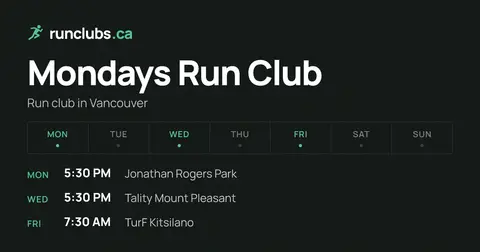
Run clubs are the easiest repeat room in Vancouver. There are dozens, most are free, and most go at a talking pace. Here's what's meeting soon:
On soon, from Remi’s run clubs list
Mon Nov 23
5:30pFri Dec 4
7:30aWed Dec 2
5:30p
Not a runner? These work just as well:
- Social sports in Vancouver
- Book clubs in Vancouver
- Dance classes in Vancouver
- Workshops in Vancouver
- Trivia nights in Vancouver
Small and structured beats big and loud
A big night out is a great time with friends you already have. It's a hard place to make new ones. You can't hear anyone, everyone came with their own group, and there's no reason to talk to a stranger.
For meeting people, look for structure: a class where you rotate partners, a supper club that seats you next to strangers, a workshop of ten people making the same thing, a run club that splits into pace groups. Small groups of eight or fewer are where conversation happens without effort. Something to do with your hands helps too.
A useful test before you go: will I be talking to the same three or four people for at least half an hour? If yes, it's a good room for meeting people.
Groups to meet, one-on-one to become friends
Groups are where you meet people. One-on-one time is where you become friends.
After two or three weeks in the same room, you'll notice someone you click with. This is the moment most people let pass. Don't. Suggest one small, specific thing while the energy is there: "Coffee after the run next week?" or "I'm going to that comedy show on Friday, want to come?"
Keep it easy to say yes to: short, nearby, with a date attached. A specific plan is far easier to accept than "we should hang out sometime", which nobody ever follows up.
Be the one who asks
Most people are waiting to be invited. Almost everyone is glad when someone else does the work. Nick Gray's point is that we like people who like us, so showing interest first is a strength, not a risk (friendshiprecession.com).
A few ways to be the initiator without it feeling like a production:
- Invite one person from your repeat room to the next thing you're already going to.
- Start a group chat for the three or four people you see every week, and post the plan.
- Host something small: four to eight people, a weeknight, food. A core of regulars plus one or two new faces each time.
- Put a standing plan on the calendar ("first Thursday is trivia") so nobody has to organise it again.
If someone says no, ask once more another week. People are busy, not uninterested. If it's no twice, let it go and ask someone else.
Being new is an invitation
If you're new to Vancouver, say so. "I just moved here" is the best opener you'll ever have. People like helping, they'll tell you their favourite places, and some will invite you along. Run clubs, language exchanges and newcomer meetups are full of people in the same position, which makes it easier.
Going alone is normal. A lot of people at any run club, class or comedy show came by themselves. You don't need a friend to bring.
A four-week plan
- Week one. Pick two repeat rooms that fit your week: one active (a run club, a league, a dance class) and one calm (a book club, a workshop, trivia). Go to both.
- Week two. Go back to both. Learn three names. Say "see you next week".
- Week three. Drop the one you liked less, if you liked one less. Keep the other. Arrive ten minutes early and stay ten minutes after; that's where the talking happens.
- Week four. Ask one person to one specific thing outside the room. A coffee, a show, a walk.
Then keep going. The hours add up faster than you'd think, and in a few months you'll have people to text on a Friday.
In-person time is the part that counts
Liking someone's stories is not the same as seeing them. A 2023 University of British Columbia study, as summarised by Nick Gray, found that seeing friends face to face at least once a week was a strong predictor of better physical and mental health (friendshiprecession.com). Group chats are great for keeping a friendship warm between meetups. They're not a substitute for the meetups.
Where Remi fits
Remi is a texting friend for Vancouver. Tell it what you're into and roughly where you live, and it sends a few things worth going to. It leans toward repeat rooms if you say you want to meet people, reminds you before the ones you say yes to, and makes it easy to bring a friend along. It can't promise anyone will be there. It can make showing up easier.
Sources
- Jeffrey Hall, University of Kansas, 2018: How many hours does it take to make a friend?
- Vancouver Foundation, 2012: Connections and Engagement survey report (PDF)
- Nick Gray: Making friends as an adult is hard. Here's the secret and Why texting your friends isn't enough